
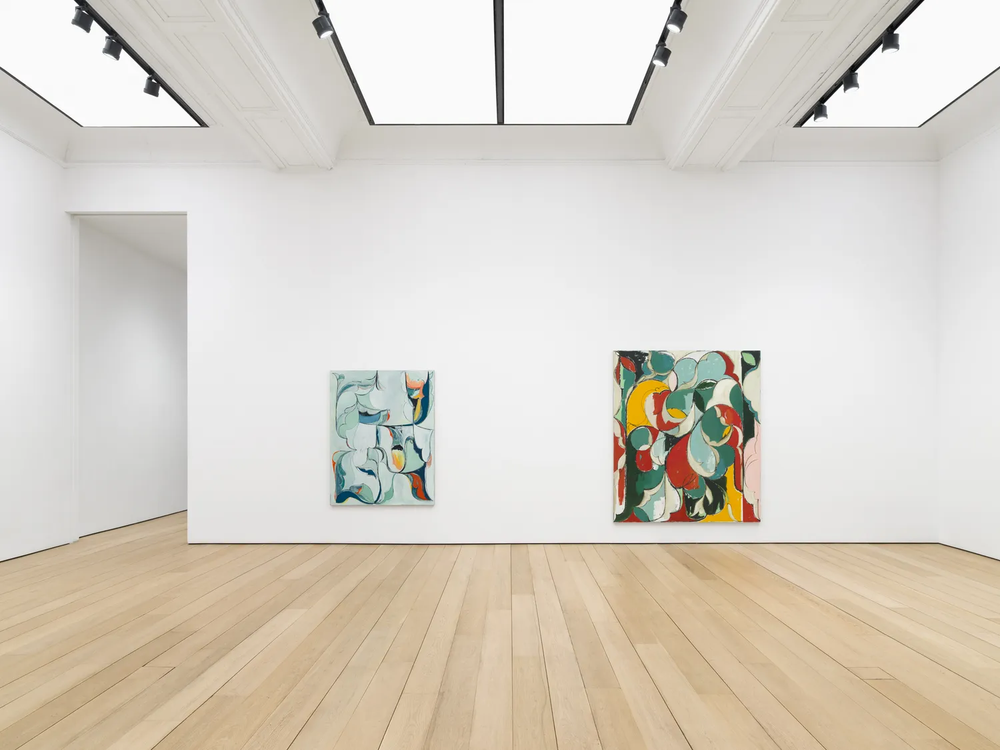
Installation view: Kamrooz Aram: Infrequencies, Alexander Gray Associates, New York, 2026
Kamrooz Aram was everywhere I happened to be these early months of 2026, and I’m all the luckier for it. He exhibited at Nature Morte in Mumbai for Mumbai Art Week, is currently on view at Alexander Gray Associates in Tribeca, and makes a rich appearance — almost a mini-solo show — in the 2026 Whitney Biennial.
Aram, born in Iran and a graduate of Columbia’s MFA program, is known for his play with the grid. It’s a project that is archeological and critical at once, as it underlies two traditions that are often understood at odds: Western modernist abstraction, on the one hand, and non-Western, and specifically Western Asian, decoration (above all, pottery and tilework) on the other. Aram’s paintings, with their gorgeous and provoking palettes (why do his colors seem so familiar and unfamiliar at once?), refuse to understand these two sources as a binary. Such a bifurcation only serves Western modernism’s insistence on self-referentiality and immanence, at the expense of other visual languages. For this painter, the organizing logic of the grid is precisely where order breaks down when it comes to understanding how line, shape, color, and arabesque relate to culture, and how cultures relate to each other.
In Mumbai, this grid was on full display, in a series of paintings that emphasized a vertical arrangement across the width of the canvas, interrupted (perhaps complicated is a better word) by curving forms that evoked both the organic (the edge of a flower petal, perhaps a limb or buttock) and the definitively non-organic (enamelwork, the inlay of precious stone in marble). The colors — reds, grays, blue-greens, midnight blues, blacks, and even yellows — likewise sit in a strange space between the natural world and the ur-natural. The problem (or pleasure) of abstraction is the way it acts as a screen for all kinds of projections on the part of the viewer, so indulge me now in my insistence that I saw in these pictures the structure, rhythm, and stylization of Henri Matisse’s “Bathers by a River” (1917), from the Art Institute of Chicago. This callback — and I’m sure this is not the only one, by far — is less a matter of influence than of recasting. It’s a reminder that Matisse’s arabesque — here and in his later abstractions and cutouts, especially — was quite literally a borrowing from Islamic decorative arts. Modernists worked their asses off to distance abstraction from the decorative, and declared ornament a crime, but not without absconding with it in the process.