
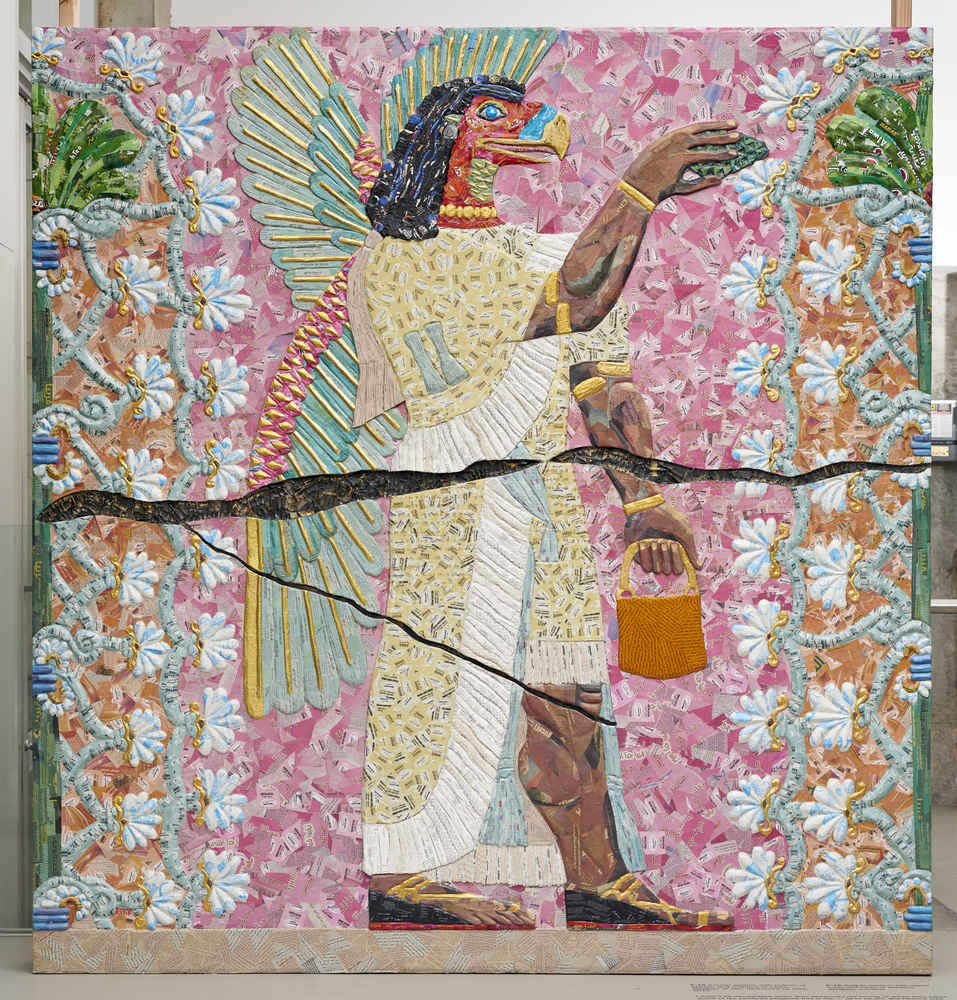
Michael Rakowitz, The Invisible Enemy Should Not Exist - (Northwest Palace of Kalhu (Nimrud), Room F, section 1, panel 15), 2019
The panel is broad, textured and insistently bright. Its figural aspects, modelled in the lowest bas-relief, are coated in confectionery colours whose levity undercuts the work’s more monumental qualities. Subtitled Northwest Palace of Kalhu (Nimrud), Room F, section 1, panel 15, the 2019 work continues Michael Rakowitz’s series ‘The Invisible Enemy Should Not Exist’ (2007–ongoing). Over nearly 20 years, the Iraqi American artist has aimed to reanimate roughly 7,000 artefacts that were destroyed or looted during the ransacking of the National Museum of Iraq in 2003, prompted by the US invasion of the country. The series has since come to encompass new devastations, like the large-scale destruction of the Assyrian sites of Nineveh and Nimrud by Islamic State in 2015.
In recreating these missing sculptures, objects and reliefs, Rakowitz relies on information from sources like the University of Chicago’s ‘Lost Treasures from Iraq’ project. Rakowitz’s versions play with physicality and absence, employing materials like Middle Eastern food packaging, Arabic newspapers, cardboard and museum labels to quite literally rematerialize the missing artefacts. But fragility and fugacity are equally central here. Rakowitz has rejected the use of the term ‘reconstruction’ when discussing these works, referring to them instead as ‘reappearances’, ‘substitutions’ or, in a more poetic vein, ‘ghosts of their originals’. These choices reflect an acceptance of entropy. ‘You can’t reconstruct the lives that have been destroyed, maimed and interrupted alongside ravaged archaeological ruins,’ Rakowitz told curator Iwona Blazwick for his 2019–20 exhibition at Castello di Rivoli.
A complex history of rupture is woven into the series. When multiple examples of Rakowitz’s Northwest Palace reliefs are exhibited together, large blank spaces are often left between them, corresponding to the dimensions of panels extracted in the 19th century and now held in Western museums and private collections. Individually, works such as The Invisible Enemy Should Not Exist – (Northwest Palace of Kalhu (Nimrud), Room F, section 1, panel 15) recreate cracks present in the reliefs that remained in situ prior to 2015. Rather than simply reiterating the fact of damage, these wounds destabilize the surface of the work in complex ways.