
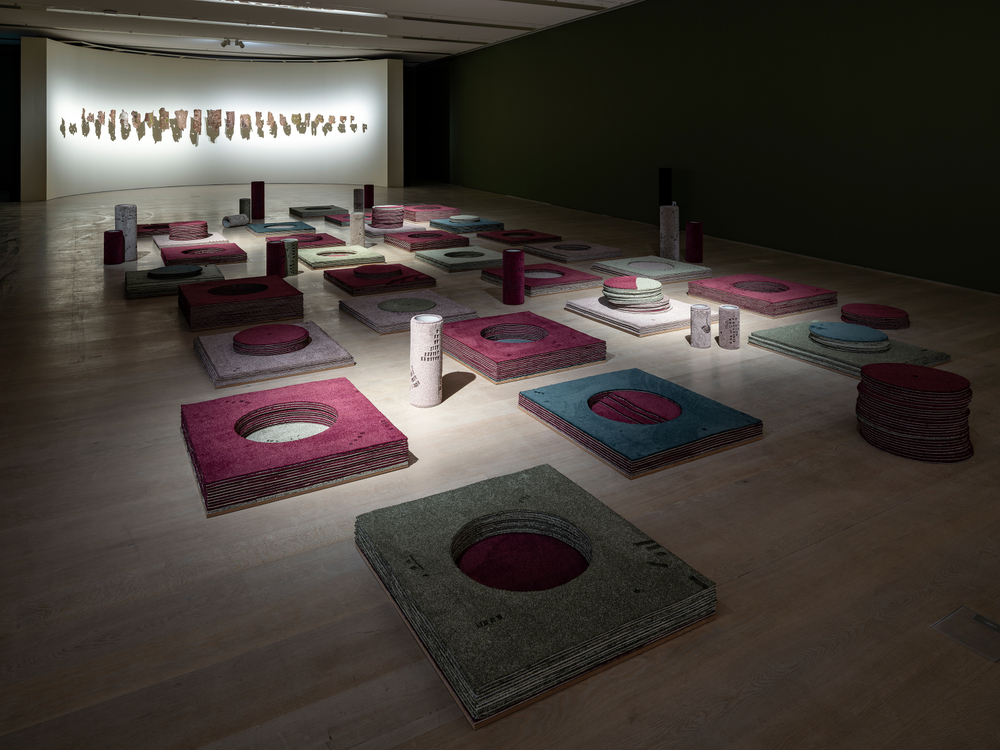
Hera Büyüktaşcıyan, Phantom Quartet
Curator: Nilüfer Şaşmazer
Installation view at Arter, Istanbul, 2025
Photo by Murat Germen
Spectres haunt ‘Phantom Quartet’, Hera Büyüktaşçıyan’s first institutional show in Turkey. Born in Istanbul to a Greek mother and an Armenian father, the artist came of age in a city shaped by erasure. From the late 19th century onwards, ravages inflicted by anti-Greek and anti-Armenian pogroms defined the multiethnic city. On 24 April 1915, Armenian intellectuals and dissidents, primarily based in the Tatavla neighbourhood, were taken from their homes in raids orchestrated by the nationalist Young Turks movement, marking the start of the Armenian genocide (1915–16). Forty years later, the 1955 Istanbul pogrom violently displaced the city’s Greek communities. The state’s appropriation of Christian-owned wealth and property lingers as an uneasy after-image. These histories cast long shadows over Büyüktaşçıyan’s new works, which explore fragility, memory and the pain of leaving the safety of one’s home.
Arter, the exhibition venue, sits on Irmak Street (River Street), perched between the hills of Tatavla and Tarlabaşı, neighbourhoods long populated by minorities. The entry section, ‘Avenue’, traces Büyüktaşçıyan’s connection to this geography with the kinetic installation The Unquiet Balcony (2025), comprising 15 wooden elements from which 22 cast-iron leaf motifs are suspended. They imitate the ornamentation of Istanbul’s neoclassical buildings, ending with acanthus and ivy forms familiar from across Tarlabaşı and Kurtuluş. These leaves sway gently, as if an invisible wind had blown into the white cube gallery. Their shadows play across the wall like silent church bells, evoking an eerie sense of absence and loss. Installed high on a wall overlooking the gallery’s staircase, the work ponders Istanbul’s violent past while inviting viewers to recognize themselves in these shifting silhouettes.
The Coat of an Early River (2025) summons further ghosts. In this installation, 25 garments in shades of green and blue – technical textiles cut into cloak-like forms – hang from a long rack. They conjure the vestments of priests who once ran Istanbul’s Orthodox schools. Büyüktaşçıyan herself attended one in the 1980s: the Galata Greek Primary School, which served as her inspiration in this work.